Veganized Pepper Steak

VeganMoFo 2016 graphic

Week Four: Memories and Traditions

One of last year’s MoFo prompts was to veganize a family recipe. Pressed for time, I didn’t actually make the recipe I chose: pepper steak. It’s been on my to-make list for literally a year, but somehow I’ve never gotten around to it — till now.

Original pepper steak recipe

A frequent fixture at family dinners, pepper steak reads to me like a retro ’70s throwback: not very fancy, maybe a little odd (ketchup + soy sauce), but total comfort food. We always served it over mashed potatoes, where the brown sauce could shine.

It’s been more than 10 years since I’ve eaten meat, and at least that long since I had pepper steak. I was curious whether the vegan version would bring me back to those childhood meals in my grandparents’ dark wood paneled kitchen. It did, 100%. And Steven — who’d never tried this retro delicacy — enjoyed it too.
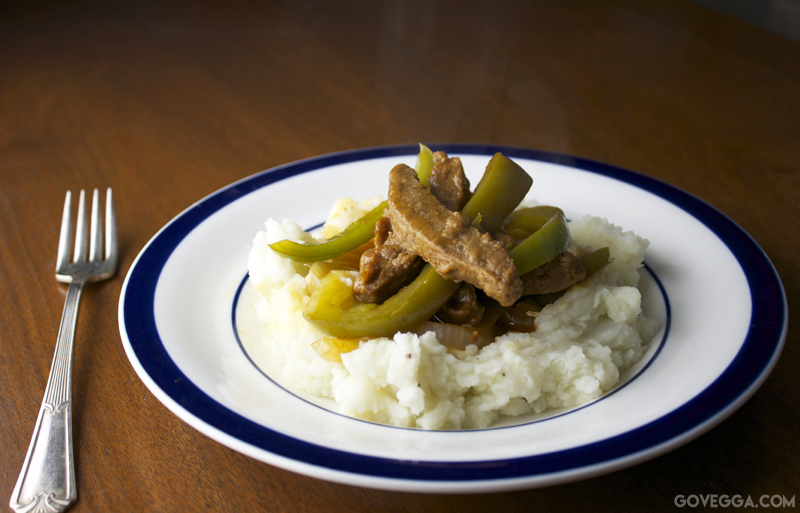
Vegan pepper steak // govegga.com

As you can see by comparing the recipe card and my recipe, I had to modify the method a bit to accommodate vegan beef strips, which don’t exactly stand up to an hour in a pan of hot liquid. But that just means this recipe comes together much quicker than the original — you’ll get it on the table in less than 30 minutes. (If serving over mashed potatoes, you can easily make them in this amount of time — just get the potatoes boiling before you start the pepper steak.)

Vegan Pepper Steak

Serves 2-3

  • 1 T neutral oil, like canola
  • 1/2 white onion, sliced into half-moons
  • 1 large green bell pepper, sliced
  • 1 package vegan beef strips (Gardein, Trader Joe’s, Wegmans)
  • 1 1/2 cup vegetable broth
  • 1 T soy sauce
  • 1 tsp vegan Worcestershire sauce
  • 1/3 C ketchup
  • 1/2 T cornstarch whisked with 1 T cold water
  • Mashed potatoes to serve

Method

In a large saucepan, heat the oil on medium. Sauté onions for about 3 minutes, then add peppers. Sauté for another 5 minutes, then add the beef strips. (Pour in a little vegetable broth if the pan gets dry.) Cook for another 5 minutes, then add the wet ingredients and simmer for ~7 minutes. Stir the cornstarch mixture into the sauce to thicken, then turn heat to low. Once the sauce has thickened slightly, serve over mashed potatoes.

PIN IT

Vegan pepper steak // govegga.com

Retro Recipe: Mustard!

VeganMoFo 2015 banner

Day 9: Most retro recipe.

During my senior year of high school, we celebrated Spirit Week, with days where seniors were encouraged to dress in various costumes. One theme was ’80s Day. My silly friends and I always had to be just a little different (read: weird), and decided that since the administration hadn’t specified WHICH ’80s they meant, it was open to interpretation. So when the rest of the senior class showed up to school in leggings and neon with teased hair, we were in silver and black and shiny things… because we were from the 2080s. We thought we were oh so clever.

You can probably see where I’m going with this.

Today’s prompt — Most Retro Recipe — got me thinking. Just how retro could I go?! Then last night, I came across this Food52 article about the history of mustard and immediately knew just how retro I would go. Guess when the first written recipe for mustard appeared? Not the 1500s or 1600s, as Steven and our friend Lara guessed when I posed the question. Nope, you have to go all the way back to 42 AD! Doesn’t that just blow your mind?! After learning just how retro mustard is, I went down a Google rabbit hole of mustard research and only surfaced for air to share some truly amazing mustard-inspired scribblings with Steven and Lara, such as this poem-recipe for mustard:

For lumbardus mustard
Take mustarde and let hit drye
Anonyn, Sir, wyturlye;
Stomper hit in a morter fyne,
And fars hit thurghe a clothe of lyne;
Do wyne therto and venegur gode,
Sturm hom wele togeder for the rode,
And make hit thyke inowghe thenne,
Whenne thou hit spendes byfore gode menne,
And make hit thynne with wyne, I say,
With diverse metes thou serve hit may.

— from Liber cure Cocorum, c. 1480

Be still, my Middle-English-loving heart! This cookbook written in verse is now my new favorite thing, and I want to cook everything from it.

But one thing at a time! Further research into historical mustard-making techniques revealed that ancient Roman mustard usually contained other nuts ground up with the mustard seeds, and that black mustard seeds were more commonly used than yellow. Intrigued, I decided to tweak the recipe a bit to come up with my own not-so-ancient Roman mustard… because the ancient Romans certainly didn’t have food processors.

Ancient Roman-Inspired Mustard
Makes way too much mustard

  • 1/2 cup black mustard seeds
  • 1/2 cup pine nuts
  • Scant 1/4 cup red wine vinegar
  • 1/2 cup water
  • 1 tsp salt

Using a mortar and pestle, grind the mustard seeds for about a minute. They should remain mostly whole. I had to grind the seeds in batches because they didn’t all fit in my mortar.

Add the ground seeds to a food processor, along with the pine nuts. Process for about thirty seconds, then add the remaining ingredients and process into a paste.

Transfer to a jar and refrigerate for 24 hours before serving.

Roman Mustard

As you can see, this mustard looks… well, different from regular ol’ mustard! It hasn’t rested its full 24 hours yet, so I haven’t tried it in its final form. I’ll be sure to report back. ;)